The Onboarding Playbook for Agencies Taking Over Someone Else's Codebase
A tactical playbook for agencies inheriting legacy software. Audit dependencies, reproduce cold builds, isolate security secrets, and set scope boundaries.
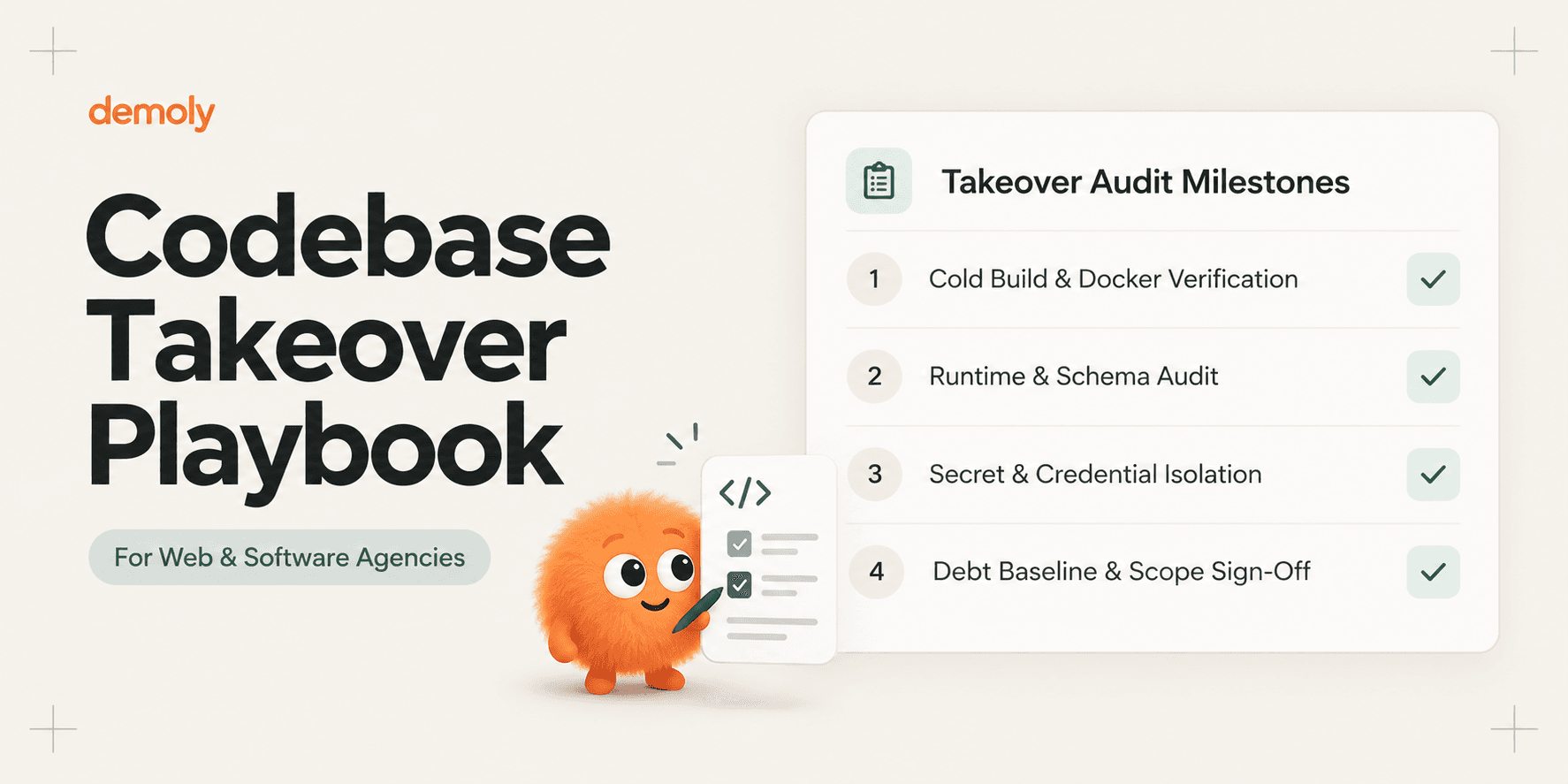
The Onboarding Playbook for Agencies Taking Over Someone Else's Codebase
Inheriting an existing application from another agency, a departing contractor, or an internal team is one of the highest-risk engagements an agency can accept. The client expects immediate momentum on new feature requests. Meanwhile, your engineering team faces undocumented dependencies, broken build scripts, and production environments held together by undocumented hotfixes.
Traditional codebase handoffs rarely go smoothly. Outgoing developers are rarely available to answer questions, and written documentation is almost always out of date. When agencies rush into active development without a structured audit, simple bug fixes trigger cascading failures across unmonitored services.
To protect agency margins and engineering sanity, you need an auditable process. This playbook outlines the exact stages your agency must execute to audit the repository, reproduce runtime environments, isolate security liabilities, and establish clear commercial boundaries before writing billable code.
What a Good Codebase Takeover Must Cover
A successful takeover requires far more than receiving repository access. To prevent unbilled debugging cycles and inherited liabilities, every takeover must verify four operational layers:
- Build Reproducibility: Your team must be able to spin up the entire application stack from scratch on a clean machine using version-controlled configuration.
- Runtime and Data Flow Mapping: Developers must understand how requests move through routing layers, database schemas, background queues, and third-party webhooks.
- Secret and Credential Hygiene: All production API keys, database credentials, and service tokens must be identified, isolated, and transferred to client-owned accounts.
- Commercial and Scope Boundaries: The agency must establish a formal baseline of existing technical debt, separating inherited defects from new scope work.
The Agency Codebase Takeover Playbook
Execute these five phases systematically during your discovery sprint before committing to feature delivery dates.
Phase 1: Repository Discovery and Build Verification
Before reviewing application architecture or touching production servers, verify that the repository builds cleanly without local machine dependencies.
- Audit Git History and Branch Hygiene: Clone the repository, inspect active branches, and confirm which commit hash matches the live production build.
- Run a Cold Build Test: Attempt a fresh build inside a blank development environment to uncover missing system libraries or undocumented package manager quirks.
- Verify Container Configurations: If the project includes Dockerfiles, confirm that container images pull and build without manual intervention or hardcoded paths.
- Inspect Package Dependencies: Review lock files to flag unpinned versions, deprecated dependencies, or libraries hosted on unmaintained repositories.
Phase 2: Architecture and Runtime Mapping
Once the code builds locally, trace how data moves through the application stack and catalog external dependencies.
- Map Database Schemas and Migration State: Review migrations to ensure local schemas match production, and verify that seed scripts run without breaking foreign key constraints.
- Catalog Third-Party Webhooks and APIs: Identify all external services, including payment gateways, transactional email providers, and search services, and document which endpoints receive inbound webhooks.
- Trace Background Jobs and Scheduled Tasks: Audit cron schedules, message queues, and background workers to prevent silent runtime failures during agency transitions.
- Review Routing and Asset Pipelines: Examine how static assets, frontend bundles, and server routes compile and deploy across staging and production CDN layers.
Phase 3: Credentials, Secrets, and Security Audit
Taking over an application means inheriting its security posture. Never leave former agency credentials active in a codebase you manage.
- Audit Environment Variables: Request an export of production environment variables and compare them against repository example files to catch undocumented configuration flags.
- Rotate Production Secrets: Immediately rotate database passwords, session signing keys, encryption secrets, and API tokens under client-owned billing profiles.
- Audit User Roles and SSH Keys: Review server SSH authorized keys, cloud IAM roles, and repository collaborators to revoke access for past developers and inactive accounts.
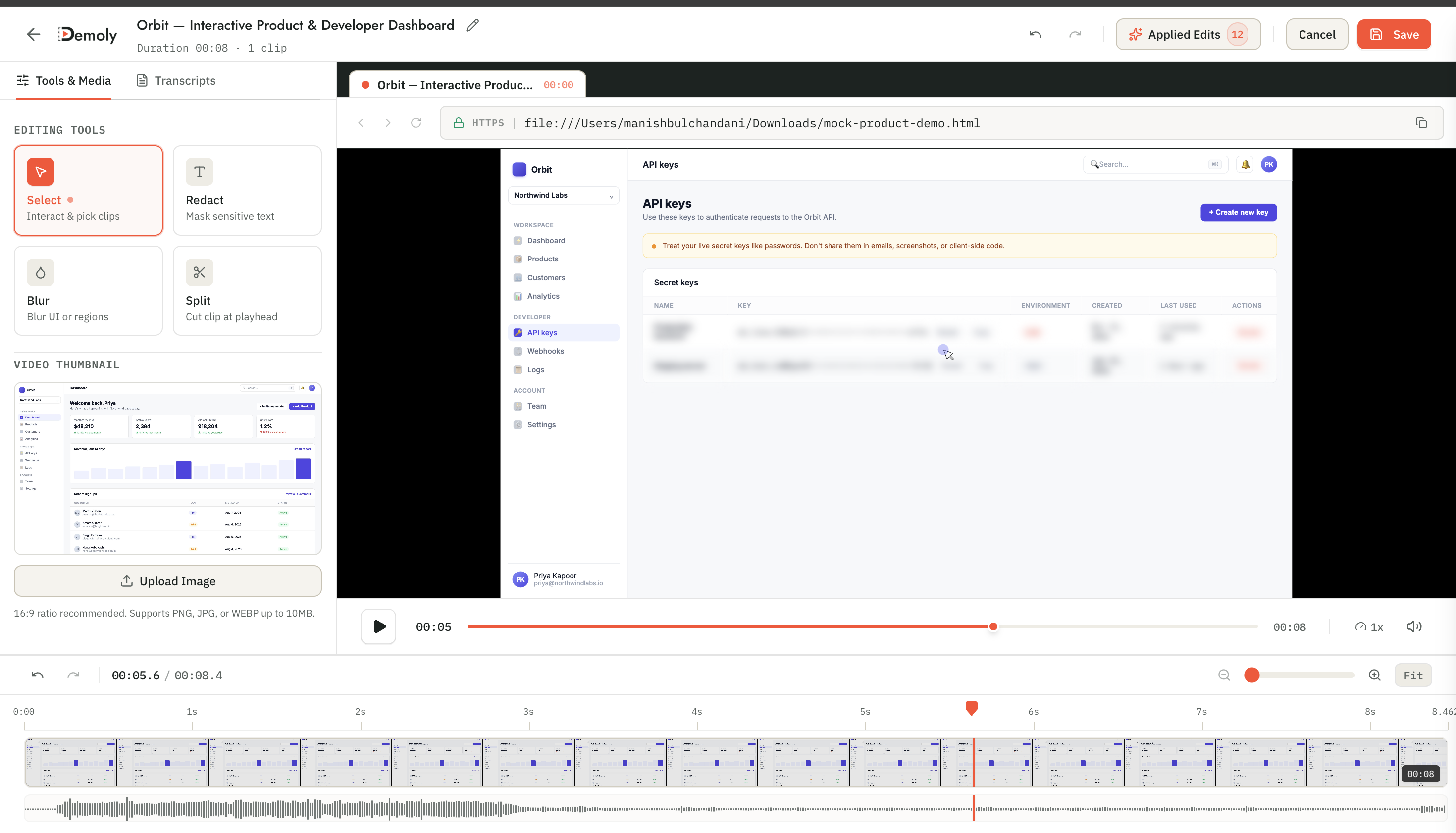
- Enforce Canvas-Layer Redaction on Video Assets: When developers record internal walkthroughs or debugging sessions, use frame-level redaction to mask live secrets and customer data before sharing links internally.
Phase 4: Technical Debt Audit and Triage
Before taking responsibility for application uptime, inventory existing flaws and categorize them by operational risk.
- Run Automated Vulnerability Scans: Execute dependency vulnerability scanners and static analysis tools to identify critical security vulnerabilities that require immediate patching.
- Assess Test Suite Coverage: Run existing test suites to document which tests pass, which fail, and which critical business paths lack automated coverage.
- Profile Performance Bottlenecks: Inspect database query logs for common issues like N+1 queries, unindexed foreign keys, or heavy frontend bundle payloads.
- Log Architectural Risks in a Triage Register: Maintain a shared register of structural debt, deprecated language runtimes, and fragile single-point-of-failure services.
Phase 5: Client Alignment and Commercial Scope Boundaries
An audit protects your team only if it sets clear commercial boundaries with your client.
- Deliver a Formal Codebase Health Report: Provide the client with an objective summary of repository health, security risks, and required infrastructure upgrades.
- Separate Remediation from Feature Delivery: Establish that repairing inherited architectural debt requires dedicated remediation sprints prior to new feature work.
- Define Defect Ownership Boundaries: Document existing application bugs so the client understands these issues precede your engagement and fall outside standard warranty.
- Establish a Phased Deployment Pipeline: Set up automated staging and continuous deployment pipelines so the client can review changes without manual server uploads.
Practical Codebase Takeover Audit Template
Use this structured scorecard during technical discovery to record repository health and share findings with client stakeholders:
- Repository Status: Git repository cloned; main branch verified against production commit; unused staging branches archived.
- Local Build Status: Stack builds successfully in isolated container; cold setup completed in 28 minutes; package locks synchronized.
- Configuration and Secrets: 14 production environment variables cataloged; cloud IAM roles transferred to client account; payment gateway keys rotated.
- Database and Migrations: Database schema version verified; automated backup snapshot validated via test restore; seed script verified.
- External Integrations: Email, payment, and search service accounts transferred; 3 inbound webhooks documented and monitored.
- Identified Critical Risks: Runtime version reaches end-of-life; 3 critical CVEs identified in legacy image processing library; test coverage below 12%.
- Remediation Action Items: Schedule a 40-hour foundational maintenance sprint to upgrade runtime dependencies and resolve critical CVEs before starting new feature development.
Common Operational Mistakes to Avoid
- Assuming Existing Documentation is Accurate: Treating outdated README files as source truth leads to wasted hours. Treat the running production environment and live database as your primary source of truth.
- Running Migrations Without Backups: Executing inherited migration scripts without an independent, verified snapshot can cause irreversible data loss.
- Delaying Credential Rotation: Postponing API key rotation leaves former developers with active access, exposing your agency to liability if a leak occurs.
- Quoting Feature Delivery Before Build Verification: Committing to delivery dates before running a cold build on a fresh machine almost always results in unbilled overruns.
Quality Check: Takeover Readiness Verification
Confirm that your engineering team has satisfied these verification criteria before concluding the onboarding phase:
- Clean Machine Build: An engineer with no prior project knowledge can clone the repository and run the application locally using only documented setup commands.
- Independent Account Ownership: The client holds direct ownership and billing administration for all hosting servers, domains, databases, and third-party APIs.
- Verified Backup Restoration: Your team has captured a production database backup and successfully restored it to an isolated staging instance.
- Sign-Off on Inherited Debt: The client has formally reviewed and signed off on the technical debt register, acknowledging that inherited defects require separate billing.
- Repeatable Deployment Workflow: Code deploys from a protected branch to staging and production environments through an automated, repeatable pipeline.
Using Demoly for Codebase Onboarding and Walkthroughs
Navigating complex legacy architectures is fundamentally visual. While README files explain package commands, they fail to show how background workflows interact with user interfaces or how obscure admin panels function.
Recording quick screen explanations is faster than writing lengthy documentation, but standard unindexed videos force engineers to scrub through timelines looking for specific configurations.
Walkthrough platforms like Demoly turn browser-based walkthroughs into searchable, interactive engineering assets:
- Record Complex Multi-Tab Workflows: Capture full technical sequences, moving from local terminals to browser developer tools, cloud hosting consoles, and database dashboards without interrupting the recording.
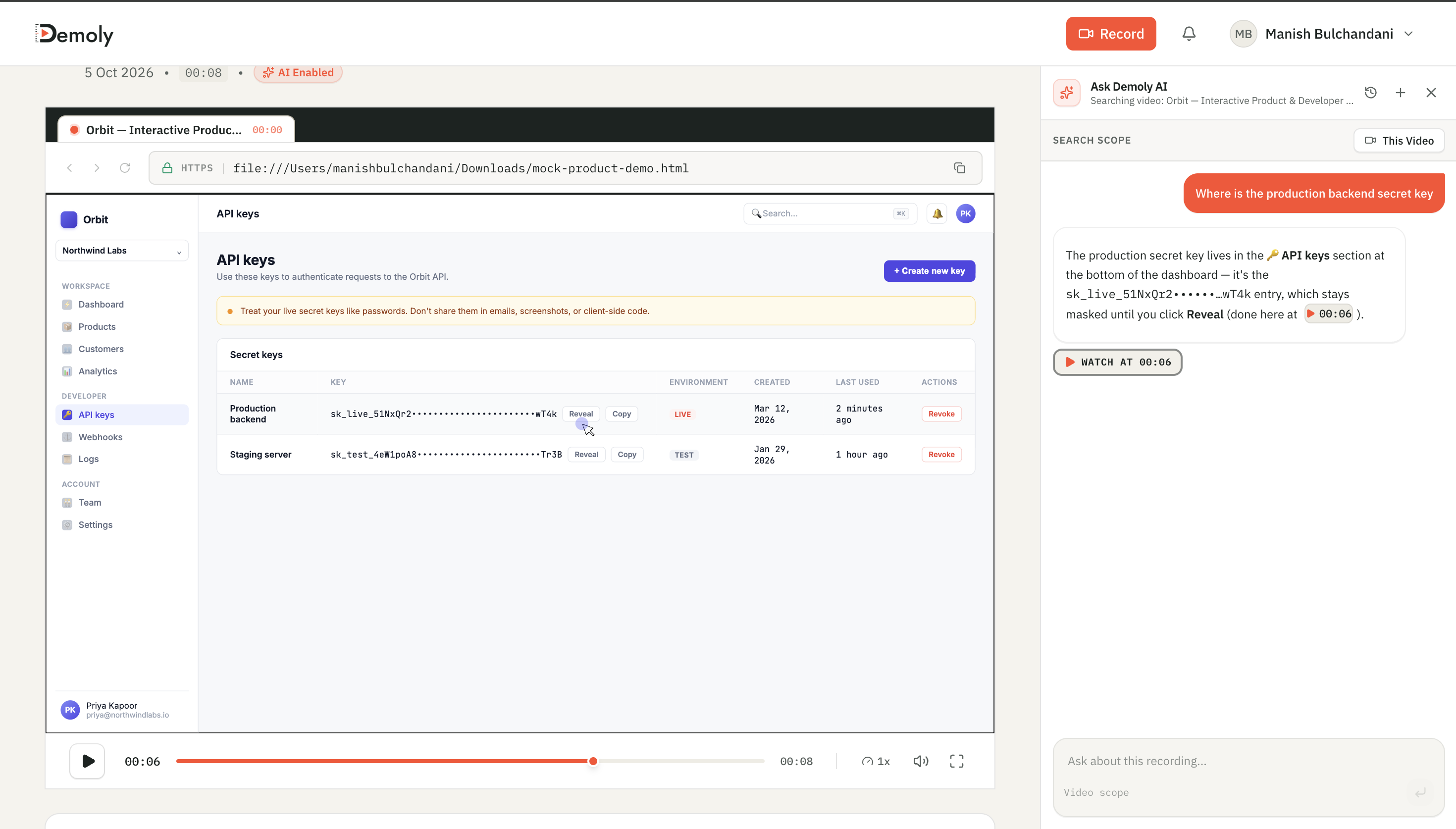
- Search Runtime Steps with Visual AI: Engineers joining the project can query the walkthrough using natural language in Demoly's AI search drawer. For example, asking "Where do we configure the Stripe webhook secret?" jumps directly to the exact visual timestamp where the setting was changed.
- Frame-Level Canvas Redaction: Automatically redact sensitive client data, production API tokens, and staging credentials at the canvas layer before sharing the recording across your agency team.
- Inspect and Copy Paused Text: Developers can pause any frame of a recorded session and directly copy code snippets, error logs, and terminal commands straight from the video player.
For a detailed walkthrough on setting up asynchronous knowledge transfers between senior engineers, see our guide on how tech leads hand off a codebase walkthrough to a new engineer.
Practical Next Steps
Make this takeover playbook your agency's standard procedure for every new legacy client engagement. Require your team to complete the discovery scorecard and obtain client sign-off on the technical debt register before scheduling sprint work.
To explore specialized video tools designed for software engineering teams and architectural walkthroughs, explore our comprehensive review of the best tool for asynchronous codebase walkthroughs.
Frequently asked questions
Commonly asked questions about this article.
01•How long should an agency spend on a technical codebase audit?
A standard codebase audit typically requires between 15 and 40 engineering hours, depending on system complexity, documentation quality, and integration volume.
02•What should an agency do if a legacy codebase has no automated tests?
Document the absence of tests in your initial audit report, establish manual smoke tests for core workflows, and quote test suite creation as a dedicated remediation sprint.
03•Why is credential rotation critical during an agency codebase takeover?
Rotating secrets immediately terminates access for former developers and contractors, protecting your agency from liability in the event of an inherited security breach.
04•How does an agency handle inherited bugs found during the audit?
Catalog all pre-existing bugs in your technical debt register, review them with the client, and agree in writing that resolving them falls outside your standard feature warranty.
05•Can engineers search specific visual actions in Demoly walkthroughs?
Yes, Demoly indexes visual actions and screen content so engineers can search natural language questions and jump directly to relevant timestamps in the browser.
Demoly Team
Contributor
Related Dispatches
View all dispatches →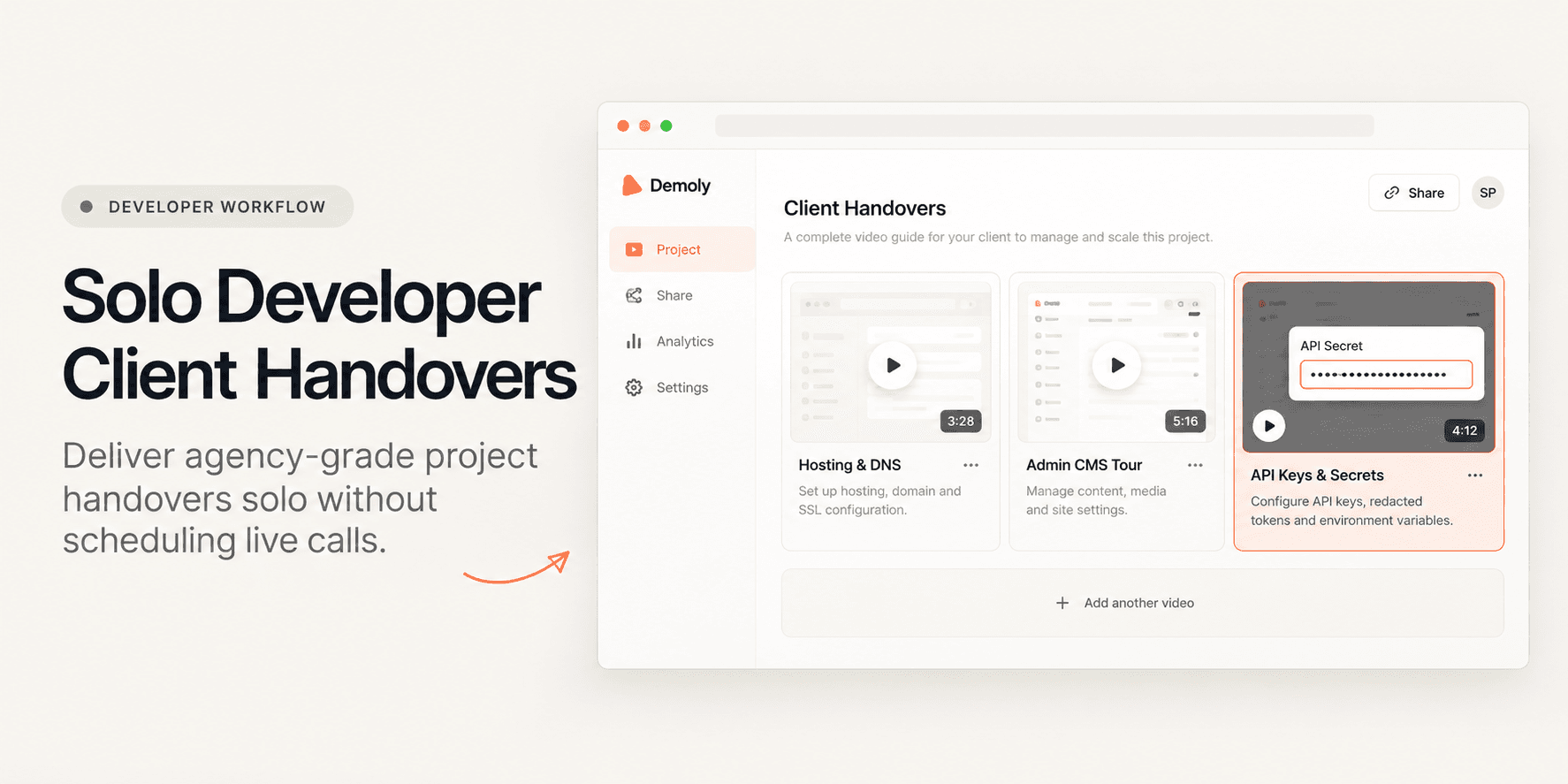
How Freelance Developers Deliver Professional Client Handovers Solo
Solo freelance developers often lose days to unpaid post-launch support and disjointed documentation. Learn how to package high-fidelity, asynchronous client handovers in under 30 minutes without scheduling another live call.
Best Tool for Customer Onboarding Videos
Compare the best tools for customer onboarding videos. Evaluate interactive AI video walkthroughs, automated voiceover guides, async screen messages, and sandbox tours.
Best Walnut Alternatives for Sales and Demo Teams
Explore the 6 best Walnut alternatives for sales, solutions engineering, and demo teams. Compare pricing, capture mechanics, and interactive searchability.
Try Demoly for your team
Create branchable, interactive demo recordings and deliverables in minutes with zero friction.