Best Arcade Alternatives for Product Walkthroughs
Looking for an Arcade alternative for product walkthroughs? Compare the top tools for interactive demos, AI-searchable video walkthroughs, and client handovers.
Best Arcade Alternatives for Product Walkthroughs
Arcade popularized interactive micro-demos by turning browser recordings into clickable, hotspot-driven product tours. While effective for short SaaS teasers and sales overviews, it creates challenges for product managers, software consultancies, customer success teams, and digital agencies handling complex applications and client handoffs.
Its biggest limitation is brittle maintenance: even minor UI or route changes can break walkthroughs, forcing teams to re-record and reconfigure steps. Linear click-tours also make finding specific answers frustrating. When users need to know something like “Where do I generate an API webhook token?”, navigating twelve mock screens is inefficient. They often abandon the tour and turn to support tickets or live demos. Teams need walkthroughs that users can query directly, not just click through.
TL;DR:
Demoly: Best for AI-searchable video walkthroughs, natural-language Q&A with timestamp jumps, permanent canvas redaction, and zero-seat-tax client handovers.
Supademo: Best for rapid interactive click-through guides, automated screenshot tours, synthetic AI voiceovers, and lightweight product tours.
Storylane: Best for enterprise sales engineering, deep front-end HTML/DOM demo capture, and personalized buyer journeys.
Navattic: Best for B2B SaaS growth marketing, ungated/gated product tour embeds, and CRM attribution tracking.
Scribe: Best for auto-generated step-by-step written SOPs, click-by-click documentation manuals, and PDF/Notion exports.
Arcade: Best for top-of-funnel marketing teasers, landing page widget embeds, and quick visual hotspot tours.
Why Teams Outgrow Arcade
While Arcade delivers an engaging aesthetic for top-of-funnel marketing snippets, teams documenting live web applications and delivering client deliverables encounter four persistent operational bottlenecks:
1. Brittle Hotspot Maintenance When Interfaces Evolve
Arcade creates demos by capturing static browser snapshots and overlaying interactive click hotspots, callout banners, and branching paths. However, real-world software is never static. When a UI element moves, a navigation menu is refactored, or copy is updated in staging or production, the entire interactive flow falls out of sync. Fixing a single step often requires re-recording the flow, manually re-aligning hotspot coordinates, editing synthetic callouts, and republishing the embed. For teams maintaining dozens of onboarding guides or client handovers, hotspot maintenance quickly turns into an unsustainable administrative burden.
2. Rigid Linear Paths Trap Answers Without Conversational Search
Interactive click-throughs demand active engagement, but they force viewers down a predetermined path. If a user only needs to answer one specific question—such as "How do I export this quarterly tax report?"—they cannot jump directly to the answer. They must click through ten irrelevant prerequisite steps, guess which branching button to press, or abandon the tour entirely. Because Arcade cannot parse natural-language questions or search across visual interaction states, it fails as an asynchronous, self-serve knowledge base.
3. Poor Fidelity for Complex Multi-Tab and Technical Workflows
Real product workflows rarely occur within a single isolated browser tab. Setting up a third-party webhook, configuring OAuth authentication, or testing payment webhooks requires jumping between the application dashboard, Stripe test environments, email inboxes, and developer documentation. Arcade’s frame-by-frame snapshot capture struggles with fluid multi-tab navigation, dynamic loading states, and live data entry. When complex workflows are reduced to stitched mock screens, the authentic operational context is lost.
4. Compounding Seat Taxes and Feature Gating on Growth Tiers
Arcade limits its free tier to just three published arcades with mandatory vendor branding. Moving to paid tiers introduces steep seat fees: the Pro plan starts at $32 to $38 per creator per month, while essential team capabilities—such as custom domains, advanced branching logic, audience insights, and blur tools—are locked behind the Growth tier, which starts at $42.50 per creator per month with substantial annual commitments. For agencies and product teams where multiple team members only need to record occasional walkthroughs, paying high recurring seat fees across the entire team is cost-prohibitive.
What to Look for in Product Walkthrough Software
Before committing to an alternative platform, product leaders and agency delivery directors should evaluate candidate software against four core operational criteria:
Conversational Visual & Spoken Search: The platform must index both spoken dialogue and silent visual interactions across the Document Object Model (DOM). Viewers should be able to type plain-English questions into an AI search drawer and immediately receive verified answers paired with clickable timestamp jumps.
Workflow Continuity & Low Maintenance: The tool should capture natural, continuous browser workflows—including multi-tab switches and dynamic interactions—without forcing creators to manually configure coordinate-based hotspots that break whenever the UI updates.
Permanent Canvas Redaction for Staging & Client Data: Product walkthroughs frequently expose sensitive information, such as production database strings, customer personally identifiable information (PII), and API secrets. The platform must physically purge sensitive data at the video canvas layer rather than applying superficial CSS overlays that can be inspected in the DOM.
Frictionless Viewer Access & Zero Seat Taxes: External clients, stakeholders, and end users should be able to view, search, and comment on walkthroughs directly in their browser without being required to create an account, install an extension, or consume a paid workspace seat.
The 6 Best Arcade Alternatives for Product Walkthroughs (Compared)
1. Demoly: Best for AI-Searchable Client Walkthroughs and Conversational Product Handovers
Demoly is an interactive walkthrough and asynchronous documentation platform built specifically for web agencies, software consultancies, and product teams. Instead of forcing users through brittle hotspot click-mazes, Demoly records authentic, continuous browser workflows and uses AI to index both spoken explanations and silent visual interactions into a conversational knowledge base.
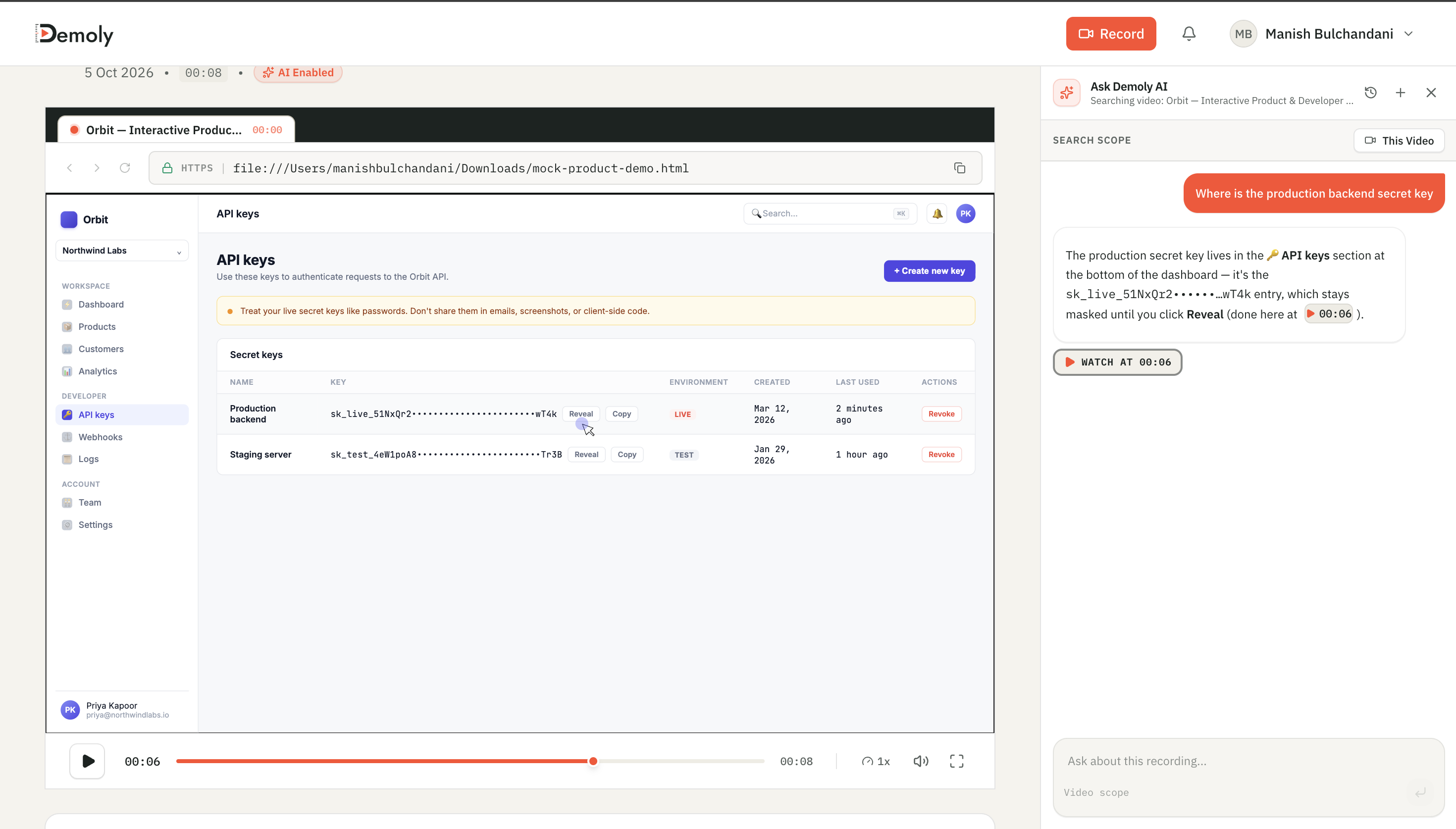
Ask Demoly AI conversational search drawer returning precise timestamp jump chip
Overview and Core Workflow
Creators capture end-to-end browser workflows using Demoly’s lightweight Chrome extension. Because Demoly supports seamless multi-tab recording, creators can demonstrate complete cross-platform user journeys—such as navigating from an internal admin dashboard into a Stripe checkout flow and back—with natural vocal narration or silent screen capture. After recording, creators can split clips, trim dead air, and cut mistaken navigation paths inside an in-browser timeline editor.
Crucially, Demoly includes built-in canvas-layer redaction. Creators can draw permanent blur masks over sensitive API tokens, customer credentials, or client financial metrics before sharing. When a recipient opens the walkthrough link, they do not have to watch a fifteen-minute video from start to finish or click through twenty sequential mock screens. Instead, they can open the Ask Demoly AI drawer and ask natural-language questions like "Where do I configure custom webhook endpoints?" The AI returns an immediate direct answer with an interactive timestamp chip (▶️ Jump to 00:06) that takes the viewer straight to that moment. Viewers can also pin timestamped feedback directly to interface elements (🎯 ), turning walkthroughs into an active two-way collaboration hub.
Where It Beats Arcade
Conversational AI search vs. rigid click paths: Viewers can ask direct questions and instantly jump to relevant timestamps rather than clicking through predetermined hotspot sequences.
Resilient to UI changes: Because Demoly records continuous video workflows, minor copy tweaks or layout shifts do not break navigation paths or require rebuilding hotspot graphs.
Permanent canvas-level redaction: Sensitive staging secrets and customer PII are permanently masked at the canvas layer before publishing, eliminating security liabilities.
Multi-tab workflow continuity: Smoothly captures user journeys across multiple browser tabs, developer consoles, and third-party SaaS portals in a single recording session.
Zero-seat viewer friction: Clients and external team members view, search, and comment on walkthroughs for free without creating accounts or paying viewer fees.
Where It Falls Short
Browser-workflow focus: Engineered specifically for web applications, SaaS dashboards, and browser environments rather than full-OS desktop software or mobile apps.
Not a simulated interactive sandbox: Demoly produces AI-searchable video walkthroughs rather than cloned interactive HTML sandboxes that allow users to type dummy text into live form fields.
Pricing and Seat Structure
Free Plan ($0/month): Unlimited video recordings, up to 15 minutes per recording, 5 AI-enabled search recordings per month, and unlimited free client viewers.
Pro Plan ($8/creator/month): Unlimited recordings, 30-minute recording duration, unlimited AI-indexed recordings, and full conversational visual search.
Agency & Team Model: Workspaces only pay for internal creators who record walkthroughs; external clients, developers, and stakeholders interact for free.
2. Supademo: Best for Interactive Click-Through Demos and Automated Product Tours
Supademo is a direct interactive demo competitor to Arcade, designed to help product marketers, customer success teams, and sales representatives build clickable product tours with automated AI enhancements.
Overview and Core Workflow
Supademo captures browser sessions as sequential screenshots while logging click coordinates in the background. Once the session ends, Supademo auto-generates interactive hotspots, hotspot tooltips, and synthetic AI text descriptions. Creators can add synthetic voiceovers, embed multi-demo showcases, and enable branching paths that guide prospective buyers down different product journeys. For an in-depth architectural comparison between interactive click tours and AI-searchable video delivery, review our complete breakdown of Supademo vs Demoly: Interactive Demos vs AI-Searchable Walkthroughs.
Where It Performs Well
Fast interactive tour generation: Quickly converts browser clicks into polished hotspot walkthroughs without manual screen stitching.
Synthetic AI voiceovers & multi-language dubbing: Automatically generates voiceovers from written step text across multiple languages.
Conditional branching: Allows creators to build "choose-your-own-adventure" product tours tailored to different buyer personas.
Export flexibility: Demos can be shared as web embeds, exported as animated GIFs, or rendered as MP4 videos.
Where It Falls Short for Technical Walkthroughs
Brittle step maintenance: Like Arcade, if an interface changes, maintaining branching hotspot paths across multiple demo variations requires substantial manual rework.
No conversational in-video search: Viewers cannot query the demo using natural language to extract specific answers; they must follow the predefined click path.
Lacks authentic human nuance: Synthetic voiceovers and discrete screenshots struggle to convey complex technical architecture and nuanced edge cases during client handovers.
Pricing and Seat Structure
Free Plan ($0): Up to 5 interactive demos with basic sharing.
Pro Plan ($27–$36/creator/month): Unlimited demos, custom branding, export options, and AI text generation.
Scale Plan ($38–$50/creator/month): Multi-demo showcases, conditional branching, and team collaboration.
3. Storylane: Best for Enterprise Sales Engineering and Deep HTML/DOM Demo Customization
Storylane is an enterprise-grade interactive demo platform engineered for sales engineering and product marketing teams that require deep control over demo data and UI personalization.
Overview and Core Workflow
Storylane offers two capture modes: screenshot-based guides and full front-end HTML/DOM capture. In HTML capture mode, Storylane clones the underlying web application code, allowing creators to edit text, swap chart numbers, and alter company logos directly inside the demo sandbox without touching production code. Sales reps can spin up customized demo environments tailored to enterprise prospects and track buyer engagement through detailed analytics.
Where It Performs Well
Front-end HTML cloning & personalization: Creators can edit text, replace images, and modify data tables directly in the cloned browser DOM.
Enterprise sales integrations: Integrates natively with Salesforce, HubSpot, Marketo, and Slack to alert sales reps when prospects engage with demo links.
Buyer intent analytics: Tracks step completion rates, viewing durations, and individual prospect drop-off points across the demo funnel.
Where It Falls Short for Product Walkthroughs
Steep learning curve: Configuring HTML-level cloned demos, variable tokens, and branching trees requires significant technical onboarding.
High enterprise pricing: Paid plans with HTML capture and CRM integrations quickly reach $500 to $1,000+ per month, making it impractical for everyday walkthroughs or client handovers.
Overkill for post-launch documentation: Building complex cloned environments is unnecessary for delivery teams who simply need clients to understand how to operate a completed web application.
Pricing and Seat Structure
Free Plan ($0): 1 published demo with screenshot capture.
Starter Plan ($40/user/month): Unlimited screenshot demos and basic integrations.
Growth Plan ($500/month): HTML/DOM capture, custom tokens, and enterprise CRM sync.
4. Navattic: Best for B2B SaaS Growth Marketing and Form-Gated Website Tours
Navattic is an interactive product tour platform focused on top-of-funnel SaaS marketing, website conversion rate optimization, and inbound lead qualification.
Overview and Core Workflow
Navattic captures web application front-ends and packages them into guided, ungated or form-gated interactive tours embedded on marketing homepages. Prospective buyers can click through product features at their own pace before booking a sales demo. Marketing teams use Navattic’s built-in conversion forms to capture buyer email addresses and push interaction data directly into marketing automation platforms.
Where It Performs Well
Website conversion optimization: Proven platform for embedding interactive "Take a Tour" CTA widgets on B2B SaaS landing pages.
Lead capture forms: Embeds lead generation forms directly inside the interactive tour at strategic milestone steps.
Marketing attribution: Syncs detailed tour engagement milestones into Google Analytics, Segment, and HubSpot.
Where It Falls Short for Technical Walkthroughs
Marketing-first focus: Engineered exclusively for top-of-funnel lead generation rather than client handovers, internal onboarding, or technical process documentation.
No self-serve search layer: Viewers cannot ask questions or search across interface elements; they are funnelled through fixed marketing sequences.
Annual contract lock-in: Navattic does not offer a self-serve monthly subscription; pricing typically starts around $500 per month billed annually ($6,000/year minimum).
Pricing and Seat Structure
Base Plan ($500/month billed annually): Unlimited tours, HTML capture, and standard CRM integrations.
Growth Plan ($1,000+/month): Advanced multi-product tours, offline demo hosting, and enterprise SSO.
5. Scribe: Best for Auto-Generated Step-by-Step Written SOPs and Click Manuals
Scribe takes a completely different architectural approach to software walkthroughs by replacing video and interactive click-tours with automated written documentation and standard operating procedures (SOPs).
Overview and Core Workflow
When activated, Scribe runs silently in the background of your browser or desktop, capturing click events, keystrokes, and URL changes. When you stop recording, Scribe immediately generates a clean, numbered document with cropped screenshots, highlighted button targets, and written step-by-step instructions. The resulting guide can be edited in minutes, shared via link, or exported directly into Notion, Confluence, or PDF manuals.
Where It Performs Well
Instant document generation: Eliminates timeline video editing, voiceover recording, and hotspot wiring by generating written guides in seconds.
Rapid scannability: Readers can scan a five-step written manual in ten seconds without sitting through a video or clicking through an interactive tour.
Universal export formats: Exports cleanly to Markdown, HTML, PDF, and knowledge bases like Notion, SharePoint, and Zendesk.
Where It Falls Short for Product Walkthroughs
Zero motion and voice nuance: Scribe does not produce video or record voice, making it incapable of explaining high-level technical decisions or nuanced workflows.
Rigid linear step structure: If a client has a question about a feature not explicitly clicked during the capture, the static document cannot provide answers.
Struggles with dynamic state changes: Cannot capture continuous animations, canvas interactions, or complex multi-step state transitions.
Pricing and Seat Structure
Basic Plan ($0): Free web-based process capture with public link sharing.
Pro Plan ($12–$23/user/month): Captures desktop applications, enables screenshot redaction, and removes Scribe branding.
6. Arcade: Best for Top-of-Funnel Marketing Teasers and Clickable Hotspot Micro-Demos
Arcade remains a strong platform for marketing teams focused on building rapid, bite-sized interactive demos for websites and social campaigns.
Overview and Core Workflow
Arcade captures browser interactions via a Chrome extension, automatically generating screenshot sequences that creators embellish with interactive hotspots, synthetic AI callouts, call-to-action buttons, and audio voiceovers. The completed "arcade" is embedded onto landing pages, shared in email marketing campaigns, or posted on social media to let prospective buyers click through a quick product teaser.
Where It Performs Well
Aesthetic presentation: Polished default styling with sleek framing, background gradients, and smooth transition animations.
Fast creation for simple micro-flows: Excellent for building 30-to-60 second marketing teasers without video editing tools.
Audience engagement analytics: Tracks viewer completion rates and click drop-offs across demo steps.
Where It Falls Short for Modern Teams
High maintenance overhead: Hotspot-based click paths break frequently when underlying product interfaces change, creating continuous rework.
No conversational AI search: Viewers cannot ask questions to jump to specific settings; they must follow rigid linear click paths.
Expensive creator seats & gated features: Free plan is restricted to three arcades with watermarking; Pro starts at $32–$38/user/month, while advanced customization and blur tools require the Growth tier ($42.50/user/month with annual minimums).
Poor fit for complex client handovers: Fails to convey continuous multi-tab navigation, complex data setups, and authentic developer nuance.
Pricing and Seat Structure
Free Plan ($0): Up to 3 published arcades with Arcade branding and basic analytics.
Pro Plan ($32–$38/creator/month): Unlimited arcades, custom branding, video exports, and basic editing.
Growth Plan ($42.50/creator/month billed annually): Branching logic, lead capture forms, audience insights, and redaction tools.
Feature and Use-Case Comparison Matrix
The table below contrasts all six product walkthrough platforms across primary use case, capture technology, viewer searchability, maintenance overhead, viewer accessibility, and starting pricing:
Tool | Primary Walkthrough Use Case | Capture & Delivery Model | Viewer Searchability | Maintenance Overhead | Client / Viewer Access | Starting Price |
|---|---|---|---|---|---|---|
Demoly | AI-searchable client walkthroughs & web app handovers | Continuous multi-tab browser recording + in-browser editor | Conversational visual + voice AI (Ask questions, jump to timestamps) | Low (Continuous video unaffected by minor UI changes) | Free (Unlimited viewers, zero login required) | Free ($0) / Pro: $8/creator/mo |
Supademo | Interactive click-through demos & marketing tours | Screenshot capture with interactive click hotspots | None (Linear click path navigation) | Medium (Requires hotspot realignment when UI updates) | Free (Public web embeds) | Free ($0) / Pro: $27–$36/creator/mo |
Storylane | Enterprise sales demos & customized buyer sandboxes | Cloned HTML/DOM capture & screenshot sandboxes | None (Predefined guided click paths) | High (Complex DOM variable management & setup) | Free (Prospect links) | Free ($0) / Growth: $500+/mo |
Navattic | B2B SaaS website tours & form-gated lead capture | Cloned front-end HTML marketing tours | None (Fixed marketing tour funnel) | High (Requires dedicated marketing setup & maintenance) | Free (Website visitors) | From ~$500/mo (billed annually) |
Scribe | Auto-generated written SOPs & click-by-click manuals | Click-event screenshot logging & written document generator | Text search across generated documents | Low (Individual steps easily edited or replaced) | Free (Public document links) | Free ($0) / Pro: $12–$23/user/mo |
Arcade | Polished marketing teasers & interactive landing page embeds | Browser snapshots with overlay hotspots & synthetic callouts | None (Linear click path navigation) | Medium–High (Hotspots break when buttons or routes shift) | Free (Public web embeds) | Free (3 arcades) / Pro: $32–$38/creator/mo |
Which Arcade Alternative Should You Choose?
Selecting the most effective Arcade alternative depends directly on your team's operational goals and how your recipients interact with your product walkthroughs:
For marketing landing page embeds and interactive lead capture: Choose Supademo for lightweight, self-serve click tours, or invest in Navattic for form-gated enterprise SaaS marketing tours.
For enterprise sales engineering and personalized HTML demo sandboxes: Deploy Storylane to allow sales reps to customize live UI data, charts, and branding for high-value prospects.
For fast, click-by-click written SOPs and employee manuals: Select Scribe to turn repetitive browser tasks into scannable written guides for Notion or Confluence.
For bite-sized top-of-funnel marketing teasers: Retain Arcade if your primary objective is embedding forty-second clickable teasers on public marketing pages.
For client handovers, web app walkthroughs, and eliminating post-launch support meetings: Choose Demoly.
Modern product delivery requires more than rigid hotspot click-mazes that break every time your application updates. By adopting a platform that pairs continuous browser video recording with an intelligent AI search drawer, your team transforms routine walkthroughs into interactive, self-serve knowledge assets that answer client questions autonomously long after delivery.
You can test Demoly with your team on the free forever plan ($0, unlimited recordings) and create your first AI-searchable walkthrough today.
Frequently asked questions
Commonly asked questions about this article.
01•Why do interactive click-tours in Arcade break when interfaces change?
Arcade relies on coordinate-based hotspots overlaid on static browser snapshots. When a development team modifies a layout, alters CSS margins, or refactors a navigation route, the hotspots point to incorrect coordinates or obsolete interface elements, forcing creators to manually re-record and re-align the entire sequence.
02•How does conversational AI search in Demoly differ from clicking through an interactive tour?
Interactive tours force viewers down a rigid, linear sequence of clicks to find an answer. Demoly’s AI search indexes both spoken voice and unvoiced visual DOM interactions, allowing users to type a natural question like *"Where are the webhook keys?"* and instantly jump to the exact visual timestamp without manual scrubbing or clicking.
03•Can I permanently redact sensitive staging secrets and API keys in walkthroughs?
Yes. While many tools rely on superficial CSS blurs that can be inspected in the browser DOM, Demoly provides permanent canvas-layer redaction. Creators can draw permanent blur boxes over API credentials, passwords, and client PII directly in the video editor before publishing.
04•Do clients or viewers need an account to watch and query Demoly walkthroughs?
No. Demoly operates on a zero-friction viewer model. External clients, contractors, and stakeholders can open walkthrough links, view videos, query the **Ask Demoly AI** search drawer, and pin element comments directly in their browser without signing up, installing extensions, or consuming workspace seats.
05•When should a team use an interactive demo tool instead of video walkthroughs?
Interactive demo platforms like Arcade and Supademo excel at top-of-funnel marketing where casual website visitors want a self-guided 30-second teaser before signing up. Continuous video walkthroughs with AI search remain superior for in-depth client handovers, technical software onboarding, and complex workflows that require spoken rationale and dynamic multi-tab context.
Demoly Team
Contributor
Related Dispatches
View all dispatches →
Best Screen Studio Alternatives for Windows and Linux
Looking for Screen Studio alternatives on Windows or Linux? Compare top cross-platform tools for auto-zoom effects, AI-searchable walkthroughs, and screen recording.
Best Guidde Alternatives for Video Documentation
Looking for a Guidde alternative for video documentation? Compare top tools for AI walkthroughs, searchable guides, written SOPs, and client handovers.
Best Scribe Alternatives for Step-by-Step Guides
Looking for the best Scribe alternatives? Compare the top tools for step-by-step guides, interactive SOPs, AI-searchable walkthroughs, and technical documentation.
Try Demoly for your team
Create branchable, interactive demo recordings and deliverables in minutes with zero friction.